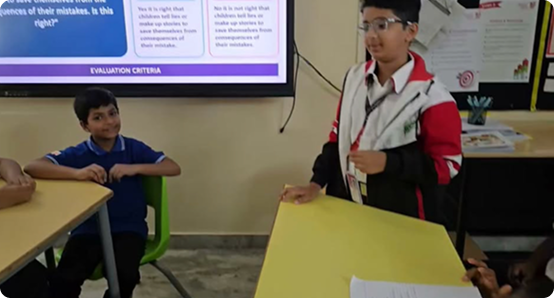

September brought another round of the Acorns Ethics Bowl, and once again, our Acorns proved that you don't need to be a grown-up to have a strong opinion.
Across three days, students from Grades 4 to 12 took on questions that were surprisingly close to their everyday lives. The younger Acorns thought about whether children would continue to learn if there were no tests or competitions, whether it is okay to lie to escape the consequences of a mistake, and whether fear or force is ever the right way to discipline children.
The conversations got more complicated as the students got older. Grades 7 and 8 discussed peer pressure, discipline and the amount of freedom children should have online. Grades 9 and 10 took on the influence of social media and gaming, academic discipline and whether children should have unrestricted access to digital entertainment. Our senior Acorns went even further, discussing the impact of social media on teenage mental health, the pressure around coaching and whether adults should step into teenage conflicts.
And some of the conversations were wonderfully honest.
One student put it simply: “I think telling the truth is scary at first, but after you tell it, you don't have to keep thinking about the lie.”
Another said, “Sometimes we say we don't care what our friends think, but actually we do.”
That is exactly what makes the Ethics Bowl so interesting. The students aren't just trying to find the “correct” answer. They are listening to one another, changing their minds, asking questions and trying to understand why someone might see things differently. That is also at the heart of the judging rubric: critical thinking, understanding beyond right and wrong, listening, respectful communication and valuing different perspectives. Silver Oaks1307261440448910
This month, we also had something special in the room: our parents.
Parents joined us as judges, listened to the discussions and watched their children wrestle with questions that are not always easy to answer. After the sessions, many stayed back to share what they had heard and how much they enjoyed being part of the experience.
For three days, classrooms became spaces for questions, disagreements, laughter and a lot of thinking.
And honestly, we wouldn't have it any other way.
Let's listen, think and share!